



2026 Healthcare Clearinghouse Buyer’s Guide for Payers and Providers
Introduction: The 2025 Landscape for Healthcare Data Exchange
In 2025, the healthcare ecosystem is under mounting pressure to move data faster, cleaner, and more securely. Between payer mandates, value-based care expansion, and growing interoperability expectations, the role of a healthcare clearinghouse has become critical.
But what is a healthcare clearinghouse today - beyond simple claims routing? For many payers and providers, the answer is evolving. Modern clearinghouses are no longer just intermediaries. They are AI-driven data orchestration hubs that connect systems, detect anomalies, and ensure compliance from eligibility through adjudication.
According to CAQH’s 2024 Index Report, automation in claims management could save up to $18 billion annually, yet inefficiencies persist due to siloed data and legacy systems. That’s where a payer-provider clearinghouse steps in offering the speed, scalability, and intelligence needed to thrive in a digital-first healthcare economy.
Evaluate Your Clearinghouse Strategy – Take the 5‑minute assessment.
Legacy Clearinghouse Functions versus AI driven Clearinghouses
At its core, a medical claims clearinghouse acts as a secure gateway between providers and payers, ensuring the smooth exchange of EDI (Electronic Data Interchange) transactions such as:
- Eligibility and benefits verification (270/271)
- Claim submission (837) and acknowledgment (999/277CA)
- Claim status inquiry (276/277)
- Remittance advice (835)
- Prior Auth/Referrals (278)
- Attachments (275)
However, modern clearinghouses like the Smart Data Solutions’ AI-driven clearinghouse extends far beyond these basics. It leverages AI-driven validation, machine learning-powered edits, and real-time analytics to minimize denials and accelerate reimbursement cycles. Our focus is on delivering prepayment integrity solutions to improve cost avoidance, enhance claim accuracy and boost operational efficiency—while reducing provider friction.
Key capabilities include:
- Smart routing: Optimizing transmission based on payer rules.
- Automated compliance checks: Ensuring HIPAA, CAQH CORE, and CMS mandates are met.
- Advanced Rules-Based Coding Validation: Automated checks for ICD, CPT, and DRG accuracy, including detection of missing modifiers, unbundled services, and payer-specific coding edits—significantly improving first-pass clean claim rates.
- Interoperability: Seamless integration with EHRs, practice management systems, and payer core platforms using modern APIs and FHIR standards—enabling real-time data exchange and reducing manual intervention.
- AI-driven insights identify patterns that lead to denials or mis payments before claims are submitted, empowering proactive corrections and improving revenue cycle performance.
“The next-generation clearinghouse is not just a conduit, it’s an intelligence layer that connects the payer-provider ecosystem,” says April Gill, CCO at Smart Data Solutions.
How to Evaluate Clearinghouse Capacity
Selecting the right clearinghouse partner in 2026 is more than a procurement decision, it’s a strategic investment in your operational efficiency. Below are key evaluation dimensions that can guide payers and providers alike.
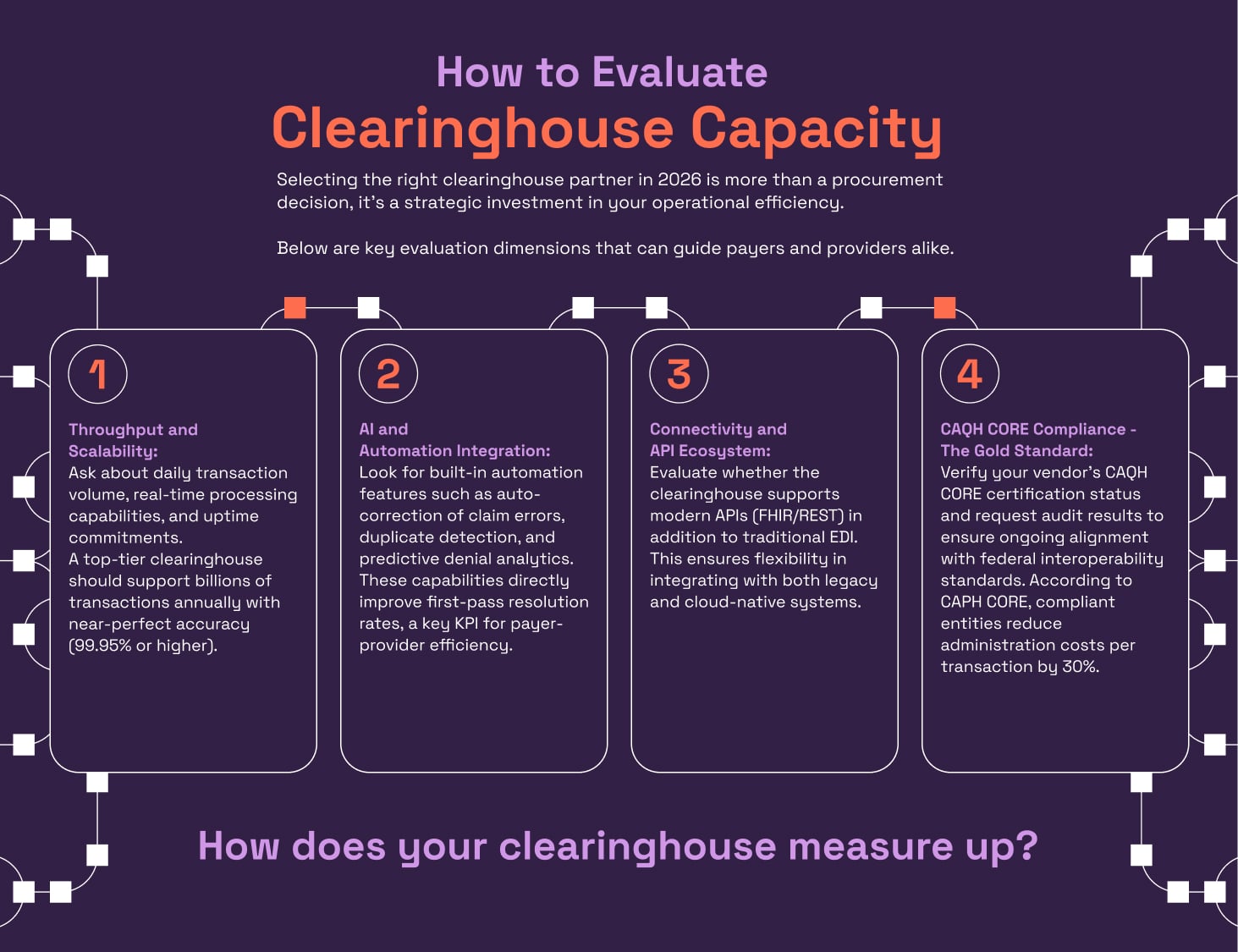
- Throughput and Scalability: Ask about daily transaction volume, real-time processing capabilities, and uptime commitments. A top-tier clearinghouse should support billions of transactions annually with near-perfect accuracy (99.95% or higher).
- AI and Automation Integration: Look for built-in automation features such as auto-correction of claim errors, duplicate detection, and predictive denial analytics. These capabilities directly improve first-pass resolution rates, a key KPI for payer-provider efficiency.
- Connectivity and API Ecosystem: Evaluate whether the clearinghouse supports modern APIs (FHIR/REST) in addition to traditional EDI. This ensures flexibility in integrating with both legacy and cloud-native systems.
- CAQH CORE Compliance – The Gold Standard: Every leading clearinghouse must adhere to CAQH CORE operating rules, which define standard transaction formats and response times. Compliance ensures that eligibility inquiries, claim submissions, and remittance advice are processed consistently and transparently across the industry.
According to CAQH CORE, compliant entities reduce administrative cost per transaction by up to 30%. When evaluating clearinghouse vendors, verify their CAQH CORE certification status and request audit results to ensure ongoing alignment with federal interoperability standards.
Why the Clearinghouse Platform Matters More Than Ever
For healthcare organizations navigating value-based models, interoperability mandates, and shrinking margins, a modern clearinghouse platform is no longer optional - it’s foundational.
With AI-enhanced validation, predictive analytics, and proactive compliance, payers and providers can turn every claim transaction into a data-driven advantage.
The Smart Data Solutions Clearinghouse Platform exemplifies this evolution, connecting, learning, and optimizing in real time to deliver smarter, faster, and more secure outcomes across the healthcare ecosystem.
Conclusion
Understanding what a healthcare clearinghouse is in 2026 means recognizing its evolution from a passive intermediary to an active enabler of payer-provider intelligence.
By evaluating vendors through the lens of capacity, compliance, and automation maturity, healthcare organizations can future-proof their operations against rising data volumes and complexity.
Curious how top-performing payers are moving beyond legacy clearinghouse models??
Schedule a Free 30-Minute Clearinghouse Discussion with our consultant.
1. What does a healthcare clearinghouse do?
A healthcare clearinghouse validates, transforms, and routes electronic healthcare transactions between providers and payers.
2. Why do payers use clearinghouses?
Payers use clearinghouses to standardize incoming transactions, reduce claim errors, and ensure compliance with industry standards.
3. How are clearinghouses evolving in 2026?
Modern clearinghouses are evolving into intelligent data platforms that combine automation, AI validation, and real-time interoperability.