



How Automation is Redefining Outsourced Claims Management

Introduction
When it comes to claims management, few areas of the healthcare lifecycle deliver greater opportunity and risk. Navigating this complex process can feel like assembling an intricate puzzle, with significant implications for all stakeholders—payers, providers, and policyholders alike. Getting it right translates to smoother operations and better outcomes.
To better understand this intricate landscape, it’s essential to know the key steps involved in claims management:
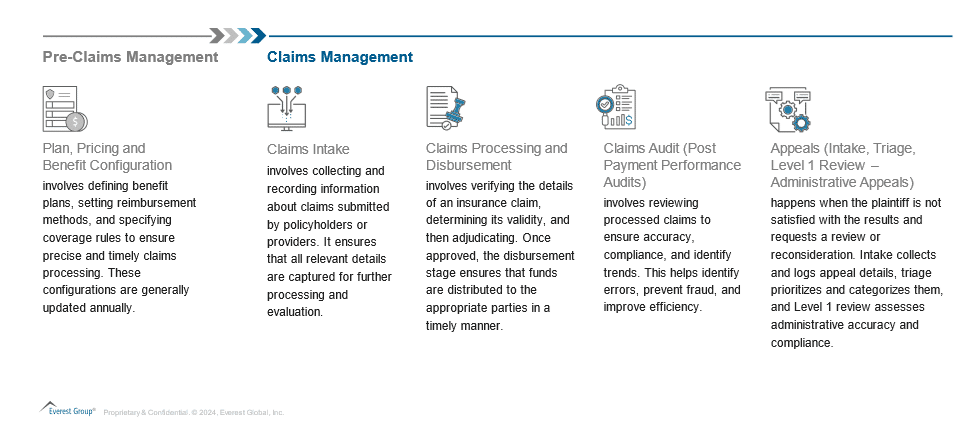
Each step in the claims management process demands specialized expertise and substantial time, making in-house management challenging. Outsourcing claims management addresses these challenges effectively, offering several benefits over in-house processing, as outlined below:
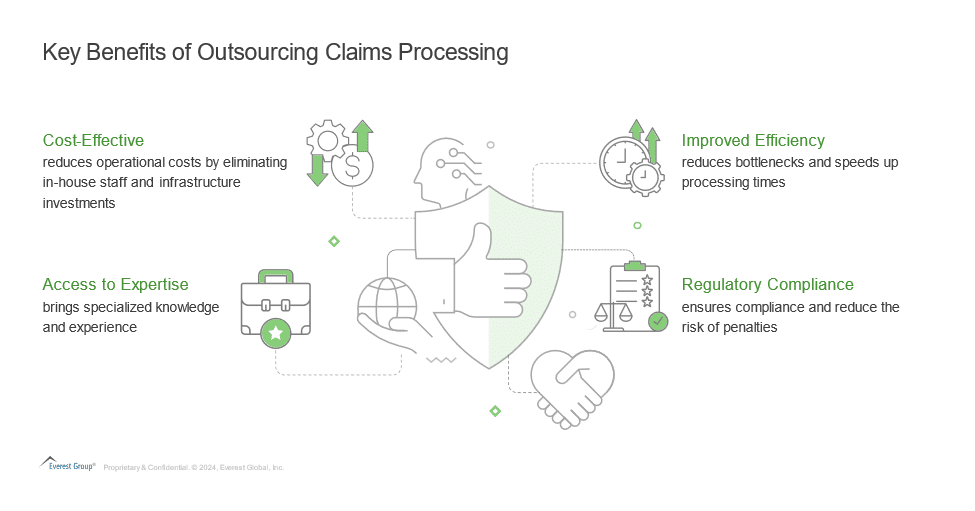
While outsourced claims management proves more effective than handling it in-house, automation-enabled outsourced claims management can offer an even greater advantage.
Pitfalls of Traditional Claims Management
As the healthcare market dynamics evolve, the limitations of traditional claims management processes become more pronounced. Traditional claims management is fraught with challenges that frequently result in inconsistencies and inefficiencies. Let’s delve into the key obstacles observed in the traditional claims management process:
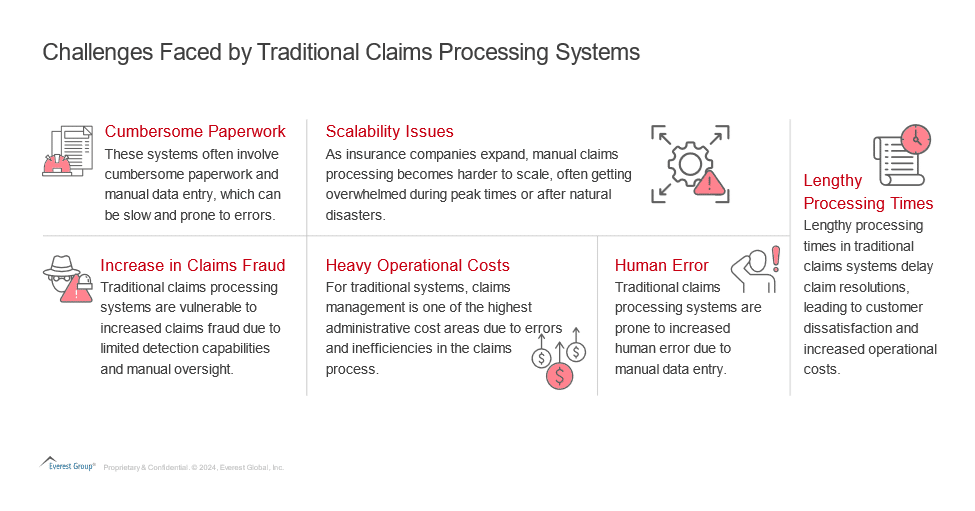
Automation addresses these pitfalls by streamlining the claims management process, making it more accurate, efficient, and responsive to the needs of healthcare providers and patients alike.
Which Claims Functions Can Be Enhanced Through Automation—and how?
Healthcare payers are increasingly seeking ways to streamline and optimize their processes, with automation emerging as a transformative solution. Automation has the potential to significantly reduce errors, accelerate processing times, and boost overall efficiency in claims management. By leveraging advanced technologies, payers can address common pain points and overcome longstanding operational challenges. While innovations in automation continue to evolve, let us explore the five key areas within claims management where adopting current automation solutions can substantially reduce inefficiencies:
1. Plan, Pricing and Benefit Configuration
Benefits configuration is generally a more people driven process, but automation allows insurers and healthcare providers to optimize staffing models (which can further reduce operational costs and allow employees to focus on higher-value tasks) by using the following technologies:
- AI (Artificial Intelligence): Can be leveraged to analyze and configure plans based on historical data and predictive analytics.
- ML (Machine Learning): Helps in optimizing pricing models and benefit configurations by learning from past data.
2. Claims Intake
Automation is improving claims intake by streamlining the data collection and entry processes using tools such as:
- NLP (Natural Language Processing): To capture information from various sources such as online forms, emails, and documents.
- OCR (Optical Character Recognition): For automated conversion paper-based claims into digital format.
- IDP (Intelligent Document Processing): Enhances OCR by extracting and classifying data from various document types.
- Chatbots and Virtual Assistants: Assist customers in submitting claims and answering initial queries.
3. Claims Processing and Disbursement
Automation is enhancing claims processing through the use of technologies such as:
- RPA (Robotic Process Automation): Automates repetitive tasks such as data entry, validation, compliance checks, claim status updates, payment disbursement and reconciliation.
- AI and ML: Can be leveraged to enhance a plethora of tasks such as fraud detection, risk assessment, detecting anomalies and facilitating faster communication between providers and payers.
4. Claims Audit (Post Payment Performance Audits)
Automated audit systems can systematically review claims to detect patterns and interpret unstructured data using:
- AI and ML: Analyze patterns and anomalies in claims data to identify potential errors or fraud.
- NLP (Natural Language Processing): Helps in reviewing and interpreting unstructured data from claims and audit reports.
Automation solution can also streamline tracking and verification at each step of the claims process, ensuring alignment with standard policies, while enabling accurate trend identification.
5. Appeals (Intake, Triage, Level 1 Review – Administrative Appeals)
Automated systems efficiently handle the intake, triage and review of appeals using tools such as:
- NLP: Used to understand and categorize appeal requests.
- AI and ML: Assist in triaging appeals (assess the urgency and complexity of each appeal) and Level 1 reviews, making recommendations based on historical outcomes.
- Chatbots and Virtual Assistants: Provide updates and information to claimants regarding the status of their appeals.
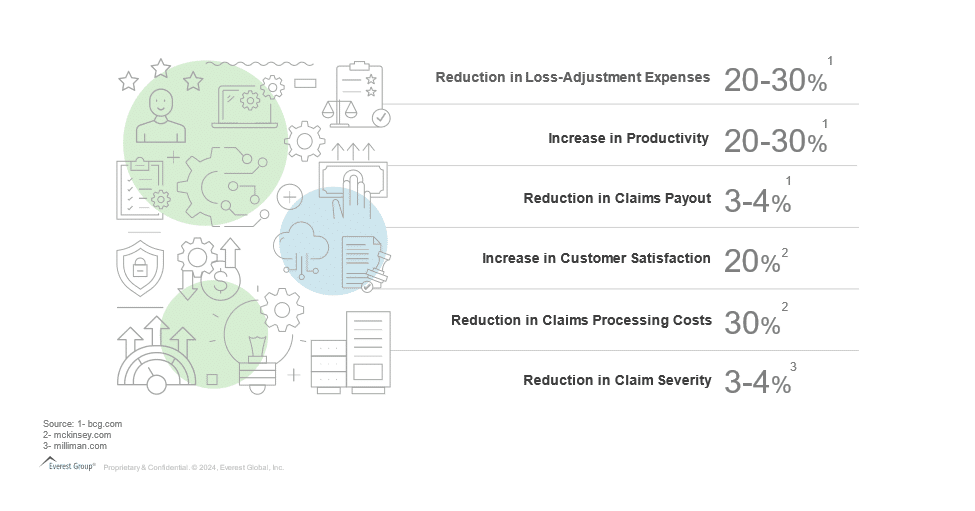
On the whole, automating claims management is the need of the hour as it several benefits as mentioned below:
Conclusion
To conclude, automation is transforming the claims management landscape by ensuring faster outcomes, reducing operational costs, and enhancing accuracy. It is streamlining the various processes- benefit configuration, claims intake, processing, audit and appeals. In an ever-evolving healthcare ecosystem, understanding and embracing technological advancements is imperative for providers and payers to provide better service for patients.
We will be closely tracking this space to see how organizations leverage advancements to enhance efficiency, improve accuracy, and ultimately deliver better outcomes in claims management.
Authors:
Lloyd Fernandes, Practice Director, Everest Group
Rushil Goel, Analyst, Everest Group
This is a guest blog from Lloyd Fernandes and Rushil Goel of the renowned research firm, Everest Group